Blog
What are the Different Types of Pipes & Fittings
Updated on Mar 2023
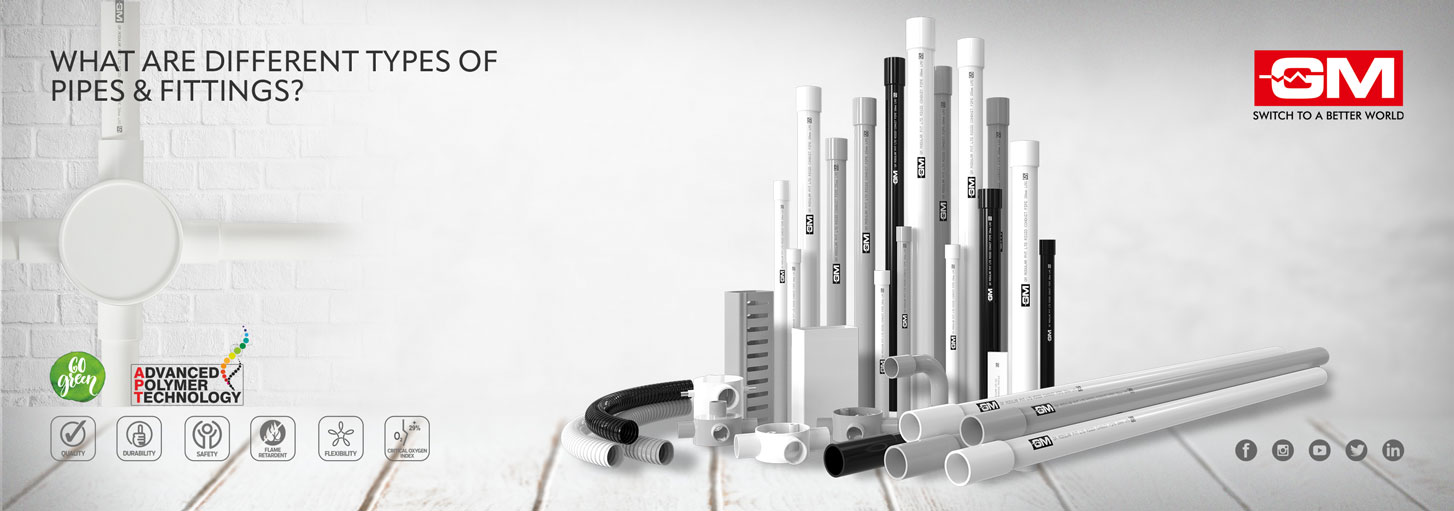
What is a pipe?
A pipe is a tubular section or hollow cylinder, usually but not necessarily a circular cross-section, used mainly to convey substances that can flow liquids and gases, slurries, powders, and masses of small solids.
Conceptually, a pipe is a connection between two processes, such that the standard output from one process becomes the standard input of the other process.
What is fitting?
A fitting or adapter is used in the pipe system to connect straight sections of the pipe or tube and adapt to different sizes or shapes and for other purposes such as regulating ( or measuring) fluid flow.
What are the different types of pipes & fittings?
There are five main types of plumbing pipe materials that are still in use today.
1) Copper pipes:- Copper pipes are commonly used in the construction industry for residential water supply lines and sometimes for drain and vent lines. Copper pipes can be manufactured as soft or rigid copper, and they offer excellent corrosion resistance and reliable connections. The three most common types of copper pipe used in residential and commercial construction are Type K, Type L, and Type M.
Copper press fitting is a flameless alternative to soldering copper pipe connections. In this system, a hydraulic tool is used to press specially designed connectors to join traditional pipes.
2) Galvanized steel:- Galvanized pipes are steel pipes that have been dipped in a protective zinc coating to prevent corrosion and rust. Galvanized piping was commonly installed in homes built before 1960. When it was invented, galvanized pipe was an alternative to lead pipe for water supply lines.
There are a variety of galvanized pipe fittings, including bushings, elbows, couplings, caps, tees, union, and core plugs. When installed properly, fittings and pipes will create an efficient plumbing system.
With galvanized pipes, galvanized couplings are used to connect two pieces of pipe together. Couplings create a tight fitting to prevent any leaks.
Caps are used to create a tight airtight secure cover for the end of a galvanized pipe. And Cored Plugs have threaded ends to close the end of the pipe. Elbows come in two different sizes, 45 and 90 degrees. And they are used to change the direction of the flow of water.
3) Polyvinyl Chloride (PVC):- A PVC pipe fitting is a detachable piece of pipe that connect two pipes or tubing. PVC fittings are also known as connectors and can be made from different materials. PVC stands for Polyvinyl Chloride, which is an affordable and easy-to-work-with material. A PVC pipe is a generally grey pipe that is used to supply and drain water. This can be either dirty or clean water.
Types of PVC fittings:- There are a few common types of PVC fitting available
Unions: Unions are similar to couplings but are designed in a way that they can be removed easily as opposed to coupling that is somehow permanent. Union has a ring in the centre that acts as a separator, hence allowing for easy deconstruction and maintenance.
Elbows: Elbow fittings commonly feature either a 45 or 90-degree bend. They are used to divert the direction of the pipe system.
Crosses: A pipe cross is a type of pipe fitting used where four pipes meet. PVC cross fitting is commonly used in the construction of the framework of PVC pipes.
Couplings: PVC coupling pipes & fitting are relatively cheap and simple. It is said to couple as it connects one pipe to another or a pipe to a fitting.
Tees: PVC tees fitting come with three ends, one at a perpendicular angle, and two in a straight line. These are commonly used in PVC structures and plumbing projects.
4) Chlorinated polyvinyl chloride (CPVC):- CPVC is a thermoplastic pipe and fitting material made with CPVC compounds meeting the requirements of ASTM specification D1784. CPVC applications are for potable water distribution, corrosive fluid handling in industry, and fire suppression systems
CPVC pipe fittings are available in size from 15 mm (½”) to 50mm (2”) and meet the requirement of ASTM D 2846 in Copper Tube Sizing (CTS). CPVC fitting from 65 mm (2.½”) to 150mm (6”) in schedule 40 per ASTM F 438 & ASTM F 439 respectively.
Related Blogs

Bladeless Fan Buying Guide: 10 Checks | GM Modular
Bladeless Fan Buying Guide: 10 Things to Check Before You Buy A bladeless fan looks like the obvious upgrade. No spinning blades, a slim tower, a quiet hum, and a price that hints it must be the better choice. But the word “bladeless” on
Read More
What Is a GaN Charger? A Simple Guide
What Is a GaN Charger? Everything You Need to Know You have probably used gallium nitride for years without knowing it. Before it reached the charger on your wall, this material lit up the first white LEDs, powered blue lasers, and read the discs in
Read More
GM Artic Air 1: 3-in-1 Bladeless Tower Fan
Why the GM Artic Air 1 Is the Ultimate 3-in-1 Appliance for Every Season Picture one slim tower in the corner of your living room. In May, it cools you through a brutal afternoon. In August, it clears the damp, stale air the monsoon leaves beh
Read More
Wireless Charging vs Wired Charging: Which Is Faster?
Wireless Charging vs Wired Charging: Which Is Faster? If your phone is at 10% and you have twenty minutes before heading out, which charger should you grab: the cable or the pad? Wireless charging is everywhere now, yet most of us still reach for a
Read More