Blog
MCB vs RCCB: Understanding Your Home's Electrical Protection
Updated on Jan 2026
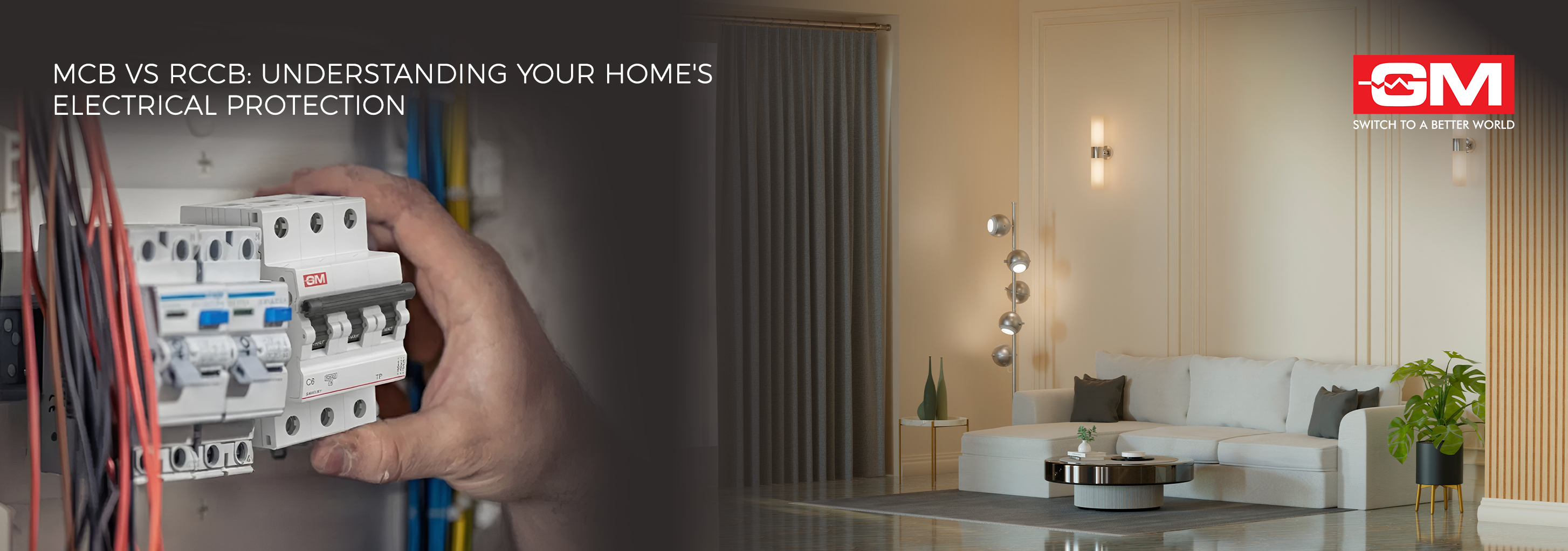
When it comes to electrical safety, many Indian homeowners find themselves staring at their distribution board, wondering what those switches actually do. You're not alone if you've confused an MCB with an RCCB; they look similar but serve very different purposes. Understanding MCB vs RCCB is essential for complete home protection, especially in India, where voltage fluctuations and high humidity during the monsoon season make electrical safety even more critical. Let's break down what each device does and why your home needs both.
What is an MCB (Miniature Circuit Breaker)?
An MCB, or Miniature Circuit Breaker, is designed to protect your electrical wiring and appliances from damage. It works by automatically tripping, or switching off, when it detects two types of faults. The first is an overload, which happens when too many appliances draw power on one circuit simultaneously. The second is a short circuit, where faulty wiring causes current to flow through an unintended path.
Think of an MCB for home use as a guardian for your home's wiring. Without it, excessive current could heat up cables and cause fires. Each MCB is rated for a specific current capacity; common ratings in Indian homes include 6A, 10A, 16A, and 32A. When a fault occurs, the MCB's thermal-magnetic mechanism responds within milliseconds. GM Modular's G-Home MCB range is designed to handle India's variable power conditions reliably. Once resolved, you simply reset the MCB; there is no need to replace fuses.
What is an RCCB (Residual Current Circuit Breaker)?
An RCCB, or Residual Current Circuit Breaker, protects people from electric shock rather than protecting wiring. It continuously monitors the current flowing through live and neutral wires, comparing the two values. Under normal conditions, these should be equal. If there's an imbalance, meaning current is leaking to the earth through an unintended path like a human body or damaged insulation, the RCCB trips immediately, typically within 30 milliseconds.
An RCCB for home installation is particularly important in areas with water exposure, such as bathrooms, kitchens, and outdoor spaces. During the monsoon season, moisture increases the risk of earth leakage through damp walls or wet appliances. RCCBs are rated by sensitivity; 30mA devices are standard for personal protection, while 100mA or 300mA devices are used for fire protection. GM Modular's G-Home RCCB detects even small leakages, preventing electric shocks before they cause harm.
To understand electrical safety devices in detail, read Working Principle of RCCB & Its Uses
MCB vs RCCB: The Key Differences
Understanding MCB vs RCCB comes down to recognising what each device is designed to protect. While both are circuit breakers that trip automatically, they respond to completely different electrical faults.
| Parameter | MCB | RCCB |
| Function | Trips on overload or short circuit | Trips on earth leakage (current imbalance) |
| Protection Type | Protects wiring and appliances | Protects humans from shock |
| Sensitivity | Responds to current magnitude | Responds to current difference (typically 30mA) |
| Response Time | 2.5ms to 50ms depending on fault severity | Under 30ms for personal protection |
| Cost | Lower | Higher |
Here's a real-life scenario: imagine using a water heater with damaged wiring. If the heating element overloads the circuit, the MCB trips and prevents a fire. But if the faulty wire touches the metal body and you touch it while showering, only an RCCB can detect current flowing through you and cut the power quickly enough to prevent serious harm.
GM Modular offers both devices in their comprehensive home protection range, ensuring you can equip your home with reliable, ISI-certified safety solutions.
Why You Need Both for Complete Safety?
A common misconception is that having one device eliminates the need for the other device. In reality, MCBs and RCCBs address entirely different threats. An MCB won't protect you from electric shock, and an RCCB won't prevent your wires from overheating due to an overload.
Both devices are housed in your distribution board, working together to provide complete home protection. Typically, the RCCB is installed before the MCBs, and the MCB helps protect the RCCB from damage caused by overload currents. This layered approach creates a unified safety system for your home.
Safety and Installation Guidelines
Now that you understand why both devices matter, here's how to ensure proper installation and maintenance.
-
Never attempt DIY electrical work. Always consult a licensed electrician.
-
Test your RCCB regularly using the test button (monthly recommended).
-
Choose ISI or BIS-certified devices to meet Indian safety standards.
-
Select appropriate ratings based on your circuit requirements.
Safety Note: Always turn off the main power supply before carrying out any inspection. For wiring and installations, consult a licensed electrician to ensure safety and compliance with local regulations.
When it comes to MCB vs RCCB, the answer isn't choosing one over the other; it's having both. Together, they form a comprehensive safety system that protects your appliances, wiring, and most importantly, your family. Check your distribution board today to ensure you have both devices installed. If you're upgrading or building new, explore quality protection solutions at GM Modular to find the right fit for your home.
For insights on different protection options, check out Types of Miniature Circuit Breakers (MCBs) & Their Uses.
Frequently Asked Questions
1. What is the main difference between MCB and RCCB?
An MCB protects wiring and appliances from overload and short circuits, while an RCCB protects humans from electric shock caused by earth leakage.
2. Do I need an RCCB if I have an MCB?
Yes. An MCB can't detect earth leakage or protect you from shock. Both serve different purposes and are essential for complete safety.
3. Which comes first in the electrical connection, MCB or RCCB?
The RCCB is installed first (closer to main supply), followed by MCBs for different circuits. This allows the MCB to protect the RCCB from overload.
4. Why does my RCCB trip frequently?
Frequent tripping indicates earth leakage, possibly from damaged wiring, faulty appliances, or moisture. Consult a licensed electrician to identify the issue.
5. Can I install these in any distribution board?
They should be installed in compatible distribution boards designed to house them safely for optimal performance.
Related Blogs

Bladeless Fan Buying Guide: 10 Checks | GM Modular
Bladeless Fan Buying Guide: 10 Things to Check Before You Buy A bladeless fan looks like the obvious upgrade. No spinning blades, a slim tower, a quiet hum, and a price that hints it must be the better choice. But the word “bladeless” on
Read More
What Is a GaN Charger? A Simple Guide
What Is a GaN Charger? Everything You Need to Know You have probably used gallium nitride for years without knowing it. Before it reached the charger on your wall, this material lit up the first white LEDs, powered blue lasers, and read the discs in
Read More
GM Artic Air 1: 3-in-1 Bladeless Tower Fan
Why the GM Artic Air 1 Is the Ultimate 3-in-1 Appliance for Every Season Picture one slim tower in the corner of your living room. In May, it cools you through a brutal afternoon. In August, it clears the damp, stale air the monsoon leaves beh
Read More
Wireless Charging vs Wired Charging: Which Is Faster?
Wireless Charging vs Wired Charging: Which Is Faster? If your phone is at 10% and you have twenty minutes before heading out, which charger should you grab: the cable or the pad? Wireless charging is everywhere now, yet most of us still reach for a
Read More